






The Tax Arbitrage That Compounds for Generations: South Dakota’s Income Tax Advantage for Irrevocable Trusts
When an irrevocable trust accumulates income — dividends, interest, capital gains, rents — the state income tax exposure depends not on where the grantor lives, not on where the beneficiaries reside, but on where the trust is administered and what law governs it. For counsel advising clients in high-tax states, that distinction represents one of the most durable and legally defensible planning opportunities available today.
South Dakota imposes no state income tax and no state capital gains tax on trust income. Not a reduced rate. Not a threshold-based exemption. Zero. For a properly structured and administered South Dakota trust, accumulated income and unrealized gains compound free of state-level drag, potentially for generations.
This article examines the mechanics of the advantage, the constitutional framework that protects it, common structuring pitfalls, and the drafting considerations practitioners should address at the outset.
The Constitutional Framework: Kaestner and the Jurisdictional Battle
The question of which state may tax trust income was meaningfully clarified — though not fully resolved — by the U.S. Supreme Court’s 2019 decision in North Carolina Department of Revenue v. Kaestner Family Trust, 588 U.S. 119 (2019). The Court held that a state may not impose income tax on an irrevocable trust solely because a beneficiary is domiciled there, at least where the beneficiary has no right to demand distribution and has received no distribution in the relevant tax year.
Kaestner did not eliminate residency-based taxation of trusts; it established constitutional limits on how far a state can reach. Most states retain the ability to tax trust income on one or more of the following bases:
- Grantor’s domicile at time of trust creation
- Trustee’s domicile or place of administration
- Beneficiary’s domicile (subject to Kaestner constraints)
- Situs of trust assets (particularly real property)
South Dakota’s structural advantage operates at the trustee and administration layer. When the trustee is a South Dakota corporate trustee and the trust is administered in South Dakota under South Dakota law, the state tax nexus exists in a jurisdiction with a zero income tax rate. The other states’ bases for taxation — grantor’s domicile, beneficiary’s domicile — may still apply and must be analyzed for each client’s facts. But the administration nexus, the most controllable variable, points to zero.
Quantifying the Advantage
The numbers are significant enough to warrant explicit analysis in any trust planning engagement where substantial wealth is involved.
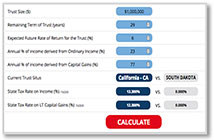
Consider a trust holding a diversified portfolio generating a 6% annualized return in a state with a 10% income tax rate on trust income (California’s top marginal rate is 13.3%; New York’s is 10.9%; New Jersey’s is 10.75%). At a $5 million starting value over a 30-year period, the compounding difference between paying state income tax each year versus paying none is not marginal — it is material. The precise delta depends on asset allocation and turnover, but for trusts holding growth assets or operating interests, the present value of avoided state income tax over multi-decade horizons can reach seven figures.
For dynasty trusts designed to persist across multiple generations, the effect is not linear. Each generation’s beneficiaries benefit from a larger compounding base precisely because the prior generation did not bleed state tax dollars. For practitioners advising families building perpetual trusts under South Dakota’s abolished rule against perpetuities, the income tax advantage is not incidental — it is a structural component of the planning.
Establishing the South Dakota Nexus
The income tax benefit is not automatic upon a client signing a trust agreement that says “governed by South Dakota law.” The trust must actually be administered in South Dakota, and that requires a qualifying trustee with a genuine presence in the state.
Under South Dakota law and the prevailing tax authority in most other states, the following elements establish South Dakota as the situs of trust administration:
- A South Dakota corporate trustee. A South Dakota-chartered non-depository trust company serving as trustee, or as directed trustee with actual administrative responsibilities, anchors the administration nexus in the state. An individual trustee nominally residing in South Dakota is unlikely to satisfy the standard in states that scrutinize trust situs aggressively.
- Administration occurring in South Dakota. Trust records, accounting, and core administrative decisions should be processed through the South Dakota trustee. Under a directed trust structure, the corporate trustee retains administrative functions (record-keeping, tax filings, distributions) while investment authority vests in the advisor-directed investment trust advisor. That structure preserves the South Dakota nexus while leaving investment management with the client’s existing advisor.
- Governing law. The trust instrument should contain an express choice-of-law clause designating South Dakota law as governing both construction and administration. Under the Restatement (Second) of Conflict of Laws and the UTC, parties generally have broad freedom to designate governing law provided the state has a reasonable relationship to the trust — which the presence of a South Dakota trustee and administration clearly satisfies.
The Directed Trust Structure and the Tax Nexus
A common concern among clients and practitioners is that engaging a South Dakota directed trustee means displacing the existing investment advisor or wealth manager. It does not. South Dakota’s directed trust statute, codified at SDCL § 55-1B-1 et seq., expressly permits the separation of investment authority from administrative trustee functions.
Under a directed trust structure:
- The investment trust advisor (typically the client’s existing RIA or family office) retains authority over investment decisions and is not subject to oversight or second-guessing by the administrative trustee on investment matters
- The distribution trust advisor (often a family member, advisor, or trust protector) may hold authority over discretionary distribution decisions
- The South Dakota corporate trustee handles trust administration, tax reporting, compliance, record-keeping, and maintains the state nexus that anchors the tax advantage
The directed trustee’s liability for the actions of the investment trust advisor is expressly limited under SDCL § 55-1B-6. This framework means clients need not choose between their trusted advisor and South Dakota’s tax environment. The two co-exist by statutory design.
Drafting Considerations for Counsel
Practitioners drafting or migrating trusts to take advantage of South Dakota’s income tax environment should address the following at the instrument level:
Choice of Law. The trust agreement should expressly elect South Dakota law for both construction and administration under SDCL § 55-3-33, which codifies South Dakota’s broad deference to choice-of-law provisions in trust instruments.
Directed Trust Provisions. Where the client intends to retain an investment advisor, include a trust advisor designation with appropriate authority, standards, and protections consistent with SDCL Title 55, Chapter 1B.
Trust Protector Provisions. A trust protector with authority to change situs, change governing law, and modify administrative provisions provides an important safety valve if the law or the client’s circumstances change. South Dakota’s trust protector statute at SDCL § 55-1B-7 provides a broad menu of protector powers.
Beneficiary Residency. Confirm the analysis for beneficiary states with aggressive trust taxation regimes. California, for example, taxes trust income allocable to California-resident beneficiaries under certain conditions (see Cal. Rev. & Tax. Code § 17742), though Kaestner significantly constrains that authority. An opinion or analysis addressing the beneficiary states’ reach should be part of the planning record.
Distribution Language. For trusts designed to accumulate income for decades, the distribution standard should be calibrated to avoid mandatory current distributions that would trigger income at the beneficiary’s state rate prematurely. Discretionary distribution language with a South Dakota distribution advisor preserves flexibility.
Conclusion
South Dakota’s zero-rate state income tax environment is not a loophole or an aggressive position. It is a straightforward consequence of where trust administration occurs under a statutory framework that both the state legislature and federal constitutional law support. For clients with significant trust wealth — particularly those in high-tax domicile states — the failure to analyze and document this advantage as part of the planning process is a material omission.
The mechanics of establishing the nexus are well-established. The directed trust structure accommodates the client’s existing advisor relationships without disruption. And the economic benefit, properly quantified over a multi-decade trust term, routinely justifies the structuring cost many times over.
Learn More
Sterling Trustees is a South Dakota non-depository trust company based in Sioux Falls. We serve as directed trustee, administrative trustee, and successor trustee for complex irrevocable trusts across the country. For questions about trust siting, directed trust structures, or working with Sterling as co-trustee on a client matter, contact Antony Joffe or schedule a call here.
Download this article
Let’s talk. Schedule a date and time to talk about the benefits to your practice of working with an independent corporate trustee.